Prices as listed by En Route.
The retailer’s price may differ.
Bookstores, parishes, and schools:
Order direct at a discount.
- Subject
- Faith and Morals
- Reading lists
- The Christian East and West
- Formats
- Paperback, Kindle, Audible
- Publisher
- En Route Books and Media
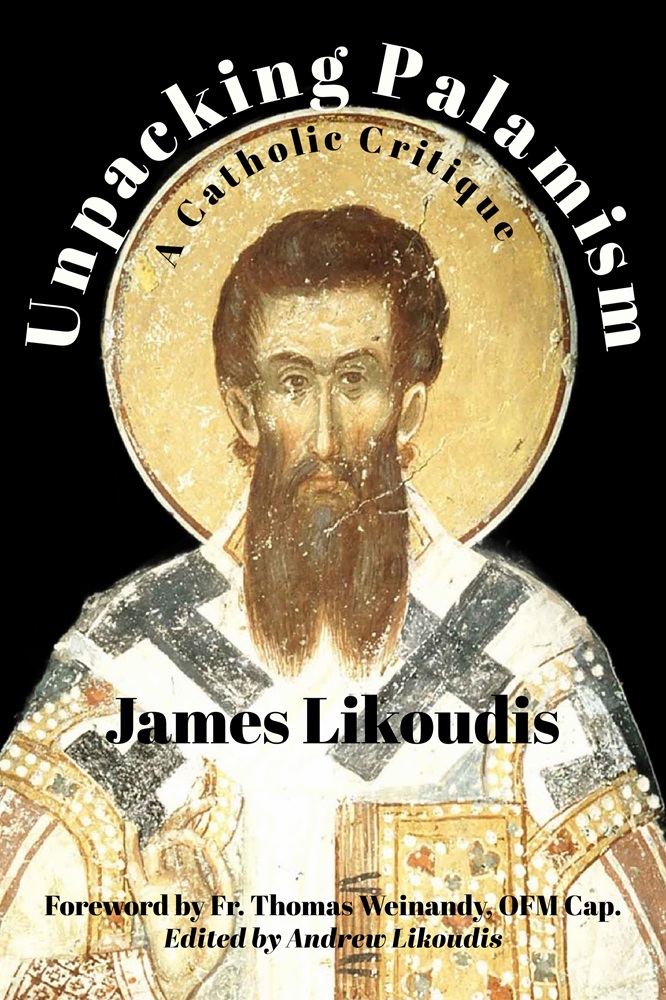
Unpacking Palamism
A Catholic Critique
Unpacking Palamism: A Catholic Critique, penned by esteemed scholar Dr. James Likoudis, meticulously scrutinizes the doctrines of Palamism, a theological construct found in Eastern Orthodoxy, but seemingly less than essential to it. This Palamite system, controversially claimed to be foundational to Eastern Orthodoxy, primarily involves the essence-energies distinction made famous by Hesychast monk Gregory Palamas. Dr. Likoudis examines the tenets of this system, discussing their place in Eastern Orthodox theology and ecumenism. He assesses the scriptural and traditional foundations of Palamism, as well as providing a Catholic lens through which to understand it, in the hopes of resolving longstanding difficulties in the way of full unity between the Catholic and Eastern Orthodox Churches.
Praise
“James Likoudis deserves much praise for this present volume, which provides a sound Catholic critique of the essence/energies distinction promoted by the Byzantine monk, archbishop, and theologian, Gregory Palamas (1296–1359). Since the 1930s, there has been a revival of interest in Palamism on the part of Eastern Orthodox Christians. Some Orthodox theologians and bishops even consider the essence/energy distinction of Palamas to be a dogma of the faith. Likoudis carefully examines the history of Palamism and the metaphysical and theological problems that some—including Orthodox—have noted in his system. This volume is enriched by an excellent foreword by Fr. Thomas Weinandy, OFM Cap. and a number of valuable appendices, especially one by Yves Congar, OP. Gregory Palamas might have been a holy monk, but the problems with his mystical theology should not be minimized or ignored.”
“James Likoudis’s Unpacking Palamism: A Catholic Critique is a most welcome and timely publication. While debate will continue over the compatibility of Palamas’s theology and metaphysics with Catholicism, there can be no disputing Likoudis’s pivotal role in bringing Palamas into the theological awareness of many Western Christians. Likoudis’s trenchant engagement with Palamas over several decades helped set the tone for Orthodox-Catholic apologetics and has had a non-negligible impact in sparking a good deal of more recent scholarly research. This alone more than justifies this publication of Likoudis’s collected writings on Palamas. However, it is Likoudis’s clear presentation of Palamas’s beautiful teaching on the Blessed Virgin Mary, the Mother of all Christians, that sets this book apart. Mary is the key to resolving remaining theological differences between Catholic and Orthodox, and Likoudis provides his readers with a guide to knowing Mary according to the mind of this ‘Pillar of Orthodoxy.’”
“Likoudis’s concise retelling of the Palamite controversy and problematic readings of Palamism, both among Catholic and Orthodox scholars, as well as his concise summary of Palamas’s Mariology, provide an accurate representation of academic positions thereon by the pars maior of Catholic theologians and can be used with great profit for becoming acquainted with the historically controversial assertions of Palamas and Palamists in both Late Byzantium and by Modern systematic theologians.”
“This work represents the capstone of Dr. Likoudis’s life-long effort toward reconciling his Eastern Orthodox brethren with the Catholic Church. His concise and informative treatment of Gregory Palamas, the famous and controversial 14th century monk of Mount Athos and Archbishop of Thessalonica, is both highly appreciative and gently critical. On the one hand, Likoudis praises Palamas’s ascetical-mystical spirituality and theology of theosis, calling his rich Mariology “sublime” and suggesting that Catholics have much to learn from him. On the other hand, he devotes two chapters to Palamas’s controversial notion of God’s “uncreated energies,” which, though distinct from God’s transcendent essence, allegedly do not compromise divine simplicity and yet can be experienced by men as the “Light of Mount Tabor.” Likoudis carefully reviews both the writings of Catholics sympathetic with Palamas as well as those who are critical. He devotes two chapters to problematic aspects of Palamism that serve as obstacles to reunion with Rome, noting how some Eastern Orthodox theologians champion Palamas as a rival to St. Thomas Aquinas, yet also noting how others such as Fr. Alexander Schmemann concede the logical necessity of a universal church’s need for a universal head in the bishop of Rome. Highly recommended.”
“The Churches of the Christian East and West have wrestled for many centuries with the question of the relationship between the uncreated and created realms. Orthodox Archbishop Gregory Palamas of Thessalonica weighed in on this matter in a period of heightened controversy related to the spiritual experiences and contemplative methods of the Athonite Hesychasts (Gk. hesychia “stillness”), forging out of the crucible of both prayer and polemics what he believed to be a theological solution found in the essence-energies distinction in God. The positive reception of this distinction as defined by the Orthodox saint has been by no means univocal in either East or West, and the emergence of a divisive and hyper-polemical neo-Palamite school in modern Eastern Orthodoxy has shed far more heat than light on the subject. In this work, James Likoudis presents a worthy synthesis of his own thinking along with several others on the matter, with varying degrees of sympathy and antipathy towards the Palamite distinction and its possible effect on the prospects of Orthodox-Catholic unity.”
About the Author

A convert from Greek Orthodoxy, James Likoudis is an internationally known apologist, one who has dedicated his life to reconciling his Eastern Orthodox brethren with the Catholic Church Jesus Christ founded. He excels in analyzing the key issues that separate Catholics and Orthodox, including regarding papal and conciliar history, and he cherishes all we hold in common in Christ.
Likoudis served for more than twenty-five years at the lay apostolate Catholics United for the Faith (CUF), including as president. His other books include The Pope, The Council, and The Mass; The Divine Primacy of the Bishop of Rome and Modern Eastern Orthodoxy: Letters to a Greek Orthodox on the Unity of the Church; Eastern Orthodoxy and the See of Peter: A Journey Towards Full Communion; Ending the Byzantine Greek Schism; and Heralds of a Catholic Russia: Twelve Spiritual Pilgrims from Byzantium to Rome. He has written and lectured widely on ecumenism, religious education, liturgy, sex education, family life, and the role of the laity in the Church. He is also a former college instructor in history and government, with over twenty years of teaching experience. Likoudis received an honorary Doctorate of Divinity from Sacred Heart Major Seminary in Detroit (2020). He and his late wife Ruth have six children, thirty-five grandchildren, and forty-five great-grandchildren.
About the Editor
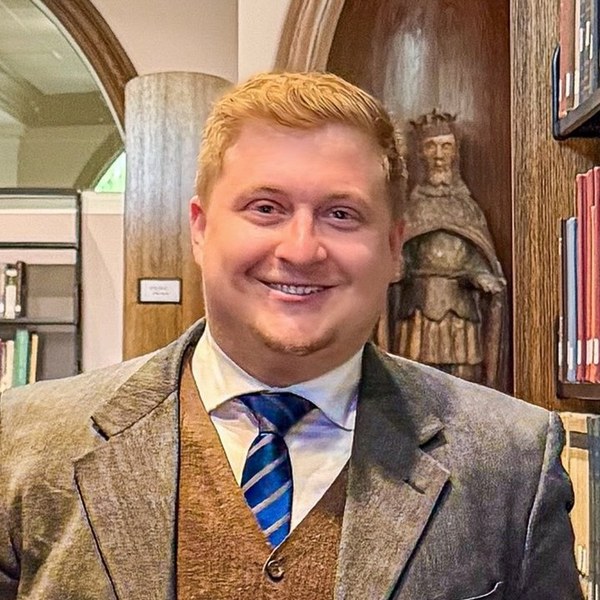
Andrew Likoudis is a Catholic scholar working in ecclesiology, ecumenism, and liturgy. He serves as Digital Editor of Where Peter Is and holds an M.A. in Catholic Studies from Franciscan University of Steubenville. He is the author of To His Face: Indefectibility and the Problem of Dissent (En Route, 2026), with a foreword by Robert Fastiggi and an afterword by Emmett O’Regan, and he organized and edited Faith in Crisis (En Route, 2025), a 40-chapter volume drawing some thirty contributors—among them Robert Cardinal Sarah, Jimmy Akin, and Mike Aquilina—with a foreword by Rocco Buttiglione, praised in Word on Fire’s Evangelization & Culture journal as “an impressive labor of love.” His most recent editorial work includes the fiftieth-anniversary edition of Yves Congar’s Challenge to the Church: The Case of Archbishop Lefebvre (En Route, 2026), which he edited and introduced, with a foreword by Larry Chapp, and the third edition of James Likoudis’s Ending the Byzantine Greek Schism (Emmaus Road, 2026), with a foreword by Scott Hahn—the opening volume of a trilogy on Catholic-Orthodox reunion. In all he has authored, edited, or compiled thirteen volumes on Catholic ecclesiology and the papacy, and published 60+ articles in outlets including the National Catholic Register, Philosophy Now, Fellowship & Fairydust Magazine, Catholic Review, and Where Peter Is.
He is the grandson of Catholic apologist James Likoudis, President Emeritus of Catholics United for the Faith, and the nephew and godson of Paul Likoudis, longtime editor of The Wanderer, the oldest national Catholic weekly in the US. As founder and president of the Likoudis Legacy Foundation, which co-sponsored the 30th Orientale Lumen Conference attended by bishops of the Catholic and Orthodox Churches, he directs the foundation’s ecumenical journal The Kydones Review, which carries a foreword from Archbishop Flavio Pace, the Secretary of the Vatican’s Dicastery for Promoting Christian Unity. Likoudis provides consulting, research, organizational strategy, and communications services to Catholic publishers, nonprofits, and institutions. He writes frequently at his Substack, Tradition & Renewal, and is a parishioner at the Baltimore Basilica—America’s First Cathedral. He enjoys kayaking, bachata, tennis, and chess. More at andrewlikoudis.com