Prices as listed by En Route.
The retailer’s price may differ.
Bookstores, parishes, and schools:
Order direct at a discount.
- Subject
- Faith and Morals
- Formats
- Kindle
- Publisher
- En Route Books and Media
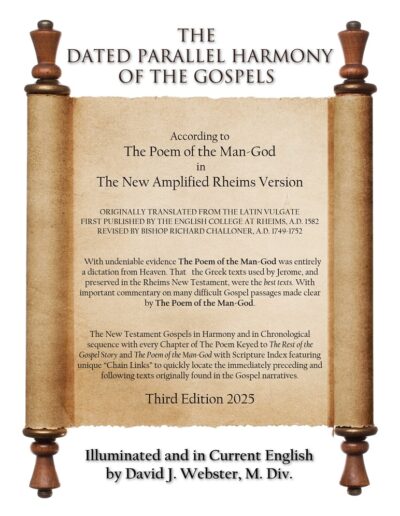
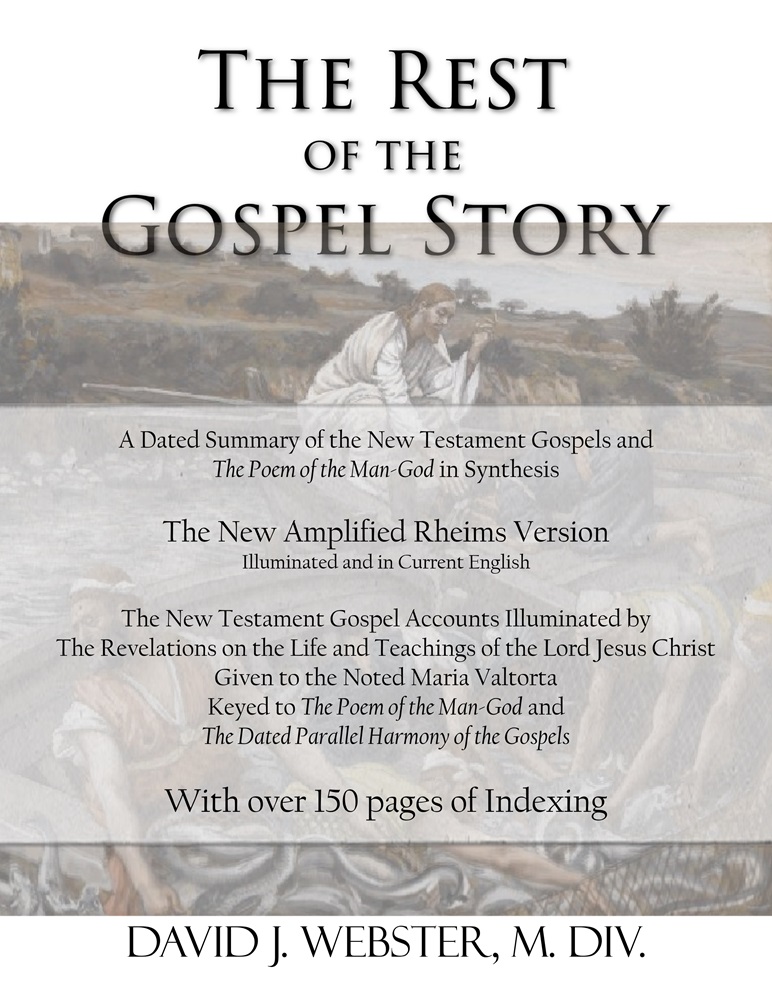
The Rest of the Gospel Story
A Dated Summary of the New Testament Gospels and The Poem of the Man-God in Synthesis
The Church distinguishes between “private” revelations, meant for personal faith and discernment, and revelations of public significance, which illuminate the Deposit of Faith but do not introduce new theological truths. The Catechism refers to these as “so-called private revelations,” emphasizing their role in helping the faithful live out their faith during specific historical periods (Catechism §§66–67). While the Magisterium provides guidance, discerning these Heaven-sent messages remains the responsibility of the faithful, reflecting Christ’s words, “My sheep hear My voice.”
Pope Paul VI’s abolition of restrictive canons in 1963 allowed Catholics to freely access, publish, and disseminate reports of such revelations, provided they align with faith and morals. Among these, The Poem of the Man-God by Maria Valtorta stands out. First published in 1947, this work, which Pope Pius XII supported, offers detailed, chronologically accurate accounts of Christ’s life. Despite technical critiques and suppression, it has garnered strong support from clergy and laity.
The Poem aligns with Our Lady’s warnings at Amsterdam (1945) and Akita (1973) about modernism and clergy-led spiritual decay. Its unique chronological precision and spiritual insight enrich the understanding of Gospel events. While the Church hasn’t formally recognized it as divine revelation, it acknowledges its freedom from doctrinal error, leaving its discernment to the faithful. Efforts are ongoing for Maria Valtorta’s beatification, affirming her as a visionary of profound significance.
About the Author
David Webster graduated from Central Baptist Theological Seminary in Minneapolis in 1971. He served for eight years as pastor of a central Wisconsin Baptist Church. It was the many mounting questions about his interpretation of the Scriptures and the incredible implications of several revelations given to Catholic visionaries that drove him into seeking out what he came to see as the Catholic faith being the complete body of faith. His own passionate love for the Scriptures, his training in Biblical Greek and Hebrew, motivated his monumental effort to update the Douay-Rheims, creating the Evangelical Catholic Study Bible which takes head on the massive misinformation and distortions of the modernist editing throughout the New American Catholic Study Bible. The Gospel episodes are also keyed to the Valtorta Gospel revelations
In addition to this massive Bible project nearly on a full-time basis for nine years, he has also been researching and writing extensively on post-Apostolic revelations to the Church, particularly the revelations given to the Italian mystic Maria Valtorta, which he considers the most important revelation Heaven has ever given to the Church since the close of the Biblical canon. He has compiled both “The Rest of the Gospel Story” and “The Dated Harmony of the Gospels,” the Gospel accounts both in parallel and for the first time in accurate chronological sequence and also keyed back to the Revelations to Maria Valtorta.
He founded Save Our Church, a group of the faithful to help expose a Chicago branch of Call to Action in his Cleveland Diocese. He has spoken at the Miles Jesu, Path to Rome Conferences in Austria and Phoenix. He has appeared on the Coming home network at EWTN and with Sandy Timco on the Lumin Christi network.
David is married to his wife Cindy, and is the Father of two wonderful daughters, who have all joined the Catholic Church. David and Cindy now have seven grandchildren.
In the Press
His Holiness Pope Pius XII, February 26,1948 (Osservatore Romano): “Publish this work as it is. There is no need to give an opinion about its origin, whether it be extraordinary or not. Who reads it will understand.” Msgr. Ugo Lattanzi, Dean of the Faculty of Theology of the Lateran Pontifical University, advisor to the Holy Office (1951): “The author could not have written such an abundant amount of material without being under the influence of a supernatural power.”
Fr. Gabrielmiles Roschini, professor at “Marianum,” Pontifical Faculty of Theology in Rome, renowned mariologist, author of 130 books, and advisor to the Holy Office (1972): “I must candidly admit that the Mariology found in Maria Valtorta’s writings, whether published or not, has been for me a real discovery. No other Marian writing, not even the sum total of all the writings I have read and studied, were able to give me as clear, as lively, as complete, as luminous, or as fascinating an image, both simple and sublime, of Mary, God’s masterpiece.” Prof. Fabrizio Braccini, University of Palerma (1979): “What constitutes the finish line for others, so to speak, is, on the contrary, Maria Valtorta’s ascetic starting point.”
Dr. Vittorio Tredici, geologist and mineralogist, Italy (1952): “I wish to underline the author’s unexplainably precise knowledge of Palestine in its panoramic, topographical, geological and mineralogical aspects.”
Fr. Gabriel Allegre, OFM, renowned translator of the Bible into Chinese, Macao/Hong Kong (1970): “The finger of God is here. As for theological justification of a book as convincing, as charismatic, as extraordinary even from a merely human point of view, as is Maria Valtorta’s Poem of the Man-God, I find it in St. Paul’s first Epistle to the Corinthians 14:6 where he writes, ‘Take me for instance brothers, of what use could I be to you, if I were to come to you speaking in tongues, but without revelation or knowledge, prophecy or doctrine?’”
H.E. George H. Pearce, S.M., former Archbishop of Suva, Fiji, now active in Providence, Rhode Island (1987): “I first came in contact with the work of Maria Valtorta in 1979 … I find it tremendously inspiring. It is impossible for me to imagine that anyone could read this tremendous work with an open mind and not be convinced that its author can be no one but the Holy Spirit of God.” Archbishop Alfonso Carinci, Secretary of the Congregation of the Sacred Rites (1946): “There is nothing therein which is contrary to the Gospel. Rather this work, a good complement to the Gospel, contributes towards a better understanding of its meaning.”
Fr. Dreyfus, of the French Biblical and Archeological School, Jerusalem (1986): “I was greatly impressed on finding in Maria Valtorta’s work the names of at least six or seven towns which are absent from the Old and New Testaments. These names are known but to a few specialists.... How could she have known these names, if not through the revelations she claims that she had.”
Fr. Agostino Bea (future Cardinal), Jesuit, rector of the Pontifical Biblical Institute and advisor to the Holy Office (1952): “I have read in typed manuscripts many of the books written by Maria Valtorta... As far as exegesis is concerned, I did not find any errors in the parts which I examined.”
Msgr. Pea qua Ia Macchi, Private secretary of Pope Paul VI, to Fr. C.M. Berti, OSM, in an hour-long interview (1963): “When His Holiness (Paul VI) was Archbishop of Milan, he read one of the books of The Poem of the Man-God. He told me how he appreciated it, and had me send the complete work to the library of the diocesan Seminary.”