Prices as listed by En Route.
The retailer’s price may differ.
Buying outside the United States
- Paperback, UKAmazon
- Kindle, UKAmazon
Bookstores, parishes, and schools:
Order direct at a discount.
- Subject
- Faith and Science
- Formats
- Paperback, Kindle, Audible
- Publisher
- En Route Books and Media
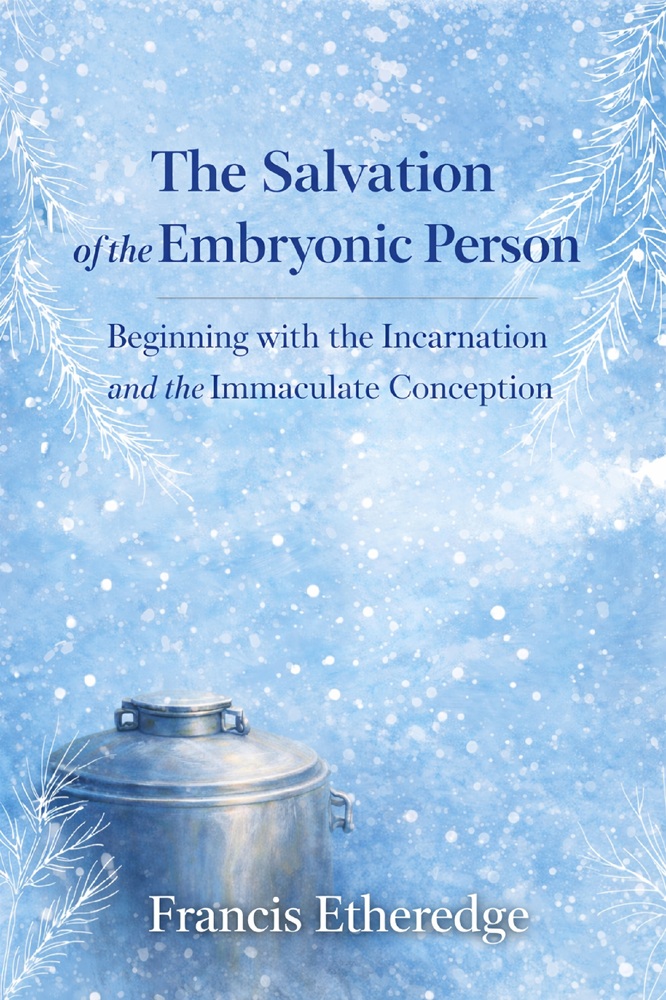
The Salvation of the Embryonic Person
Beginning with the Incarnation and the Immaculate Conception
Why does salvation begin with embryonic human children? Because this is where God began – both in the case of Mary’s Immaculate Conception and in the Incarnation of the Son of God. So we are following the initiative of God Himself who, having thought of us from all eternity, longs to bring each one of us to give glory to God for calling us to exist in relationship to Him and to others.
And, just as St. John XXIII said that human life is sacred because of the action of God, so all these different, glowing, golden threads show that God seeks us before we are born. And, therefore, we are not born cold. We come to exist surrounded by grace, as an electromagnet surrounds a wire to induce a current in it. The current is the impulse God gives us to seek the salvation that comes to us through Jesus Christ.
Praise
“Francis Etheredge’s brilliant arguments amply demonstrate the reality of human personhood from the moment of conception. This creative synthesis of philosophy, theology, and science is essential reading for anyone interested in demystifying the current controversies in bioethics.”
“This book by Francis Etheredge offers a profound and prompt theological meditation on the dignity of embryonic human life through the lens of the Annunciation. With intellectual rigor and pastoral sensitivity, it confronts the tragic reality facing nascent persons while situating that reality within the realm of salvation history. Drawing on Scripture, magisterial teaching, and careful analysis, the author illuminates how each human conception echoes the beginning itself. Particularly compelling as it is rooted in Marian theology and divine mercy. This work is both challenging and hope-filled—a significant contribution to contemporary bioethical and theological discourse.”
“Francis Etheredge’s new work, The Salvation of the Embryonic Person presents a fresh and clear appeal to the conscience of the modern world regarding the existence, plight and fate of frozen embryonic life. Combining a rich theological precision with a lucid understanding of the biological realities of the act of conception, Etheredge places in the spotlight the excesses of the artificial fertilization industry, the proliferation of embryonic human life as medical “material” for experimentation or discarding, and the Church’s manifest need to respond with a solidly grounded theological-pastoral approach to this very real need. This work is a clarion call to the pro-life movement to take a hard look at the terrible reality beyond the merely abortifacient industry and recognize the reality of children conceived in vitro and kept in preservation for an uncertain fate. Moreover, his theological-scriptural precision presents a compelling argument for embryonic adoption as a viable moral choice in the modern world. Etheredge’s perspective is simultaneously strictly Catholic and immanently merciful, a rare combination in presenting theology of this kind. I wholeheartedly recommend this work for anyone involved in pro-life ministry, legislation, and to the wider community of theologians and pastors.”
“All men, even we the Catholic faithful, often fail to view our own struggles as well as other people’s trials within the context of Faith. Yet, this is precisely our calling. The essential reason we even live our Faith is to encounter and to be in deep relationship with Jesus throughout our life on Earth and, hopefully, eternally in Heaven. In his most recent book, The Salvation of the Embryonic Person: Beginning with the Incarnation and the Immaculate Conception (2026), author Francis Etheredge directs us to understand and value all the ages and stages of human life, most specifically in this writing the embryonic, as precious and intended and loved by God, as mind, body, and soul, as human. Etheredge explores the tragic reality of frozen embryos, discarded embryos, and abortifacient pharmaceuticals; and, ultimately, he contends that the answer to all these anti-life issues is recognizing personhood in light of the Incarnation. Etheredge’s book encourages the reader to question: Do I imagine, contemplate upon, and meditate within the Incarnation, Jesus within Our Lady’s most immaculate womb, to help me to genuinely know myself as well as to know, respect, and protect the lives of others from conception through natural death? This reflection teaches that it is knowing and loving who we really are, created in the Image of God, that we will truly know and deeply love others. Loving and defending sacred embryonic life manifests differently for everyone. We must listen to the Holy Spirit and learn what our individual calling is. + Come, Holy Spirit. +”
“The Salvation of Embryonic Human Life is a challenging book, intellectually, morally, and spiritually.... I strongly recommend [it] to bioethicists, theologians, physicians, jurists, and all those who are committed to thinking seriously and responsibly about the beginning of human life. It is a work that does not evade complexity, but neither does it surrender to despair.”
“Drawing from Scripture, magisterial teaching, and a profound Marian imagination, Francis Etheredge offers a fresh theological meditation on the dignity of nascent human life. By returning to the Annunciation, the very moment when God’s love took flesh, he invites readers into a deeper spiritual encounter with the truth that every human life is held, known, and loved by God. This creative integration of Mariology and moral theology will resonate with those seeking a theological, contemplative, and compassionate vision of human dignity.”
“Embryonic humanity can be seen as the ultimate target of this demonic assault on God’s creation. The smallest and most helpless are paying the highest price. Francis Etheredge’s account of their fate is a major contribution to placing their situation in its true anthropological and theological context.”
“Etheredge unveils the luminous truth that God meets us first in our earliest beginnings. His meditation draws golden threads between grace and existence, showing how salvation awakens within the very sanctity of embryonic life.”
About the Author

Mr. Francis Etheredge is married with eight children, plus three in heaven.
Francis is currently a freelance writer and speaker and his “Posts” on LinkedIn can be viewed here. Poetry; short articles; autobiographical blog; excerpts from books; and “Philosophize: A Ten Minute Write.”
For a list of all of Francis’ books published by En Route Books and Media, click here.
See Francis’ other books, too, entitled Scripture: A Unique Word, From Truth and truth: Volume I-Faithful Reason, From Truth and truth: Volume II: Faith and Reason in Dialogue, From Truth and truth: Volume III: Faith is Married Reason.
He has earned a BA Div (Hons), MA in Catholic Theology, PGC in Biblical Studies, PGC in Higher Education, and an MA in Marriage and Family (Distinction).
Enjoy these additional articles by Francis Etheredge:
Reviews
- Review by Dr. Pravin Thevasathan
I have been sent an advanced copy of this excellent book to review. Life begins at conception. That is a simple scientific fact. So, what is the fate of embryonic human life generated as a result of In Vitro Fertilisation (IVF)?
As the author notes, human rights are widely available, but not for these tiny little human beings. The author persuasively argues that these cryopreserved human embryos deserve to be granted human rights.
What the author does somewhat uniquely is to examine the issue in the light of the Incarnation. Issues surrounding IVF are ethical, but they are also theological. When we reflect on God becoming Incarnate in the womb of Mary, we have theological reasons to respect the human embryo.
Is the human embryo a potential human being or a human being with potential? Even to ask this question is insufficient. As the author persuasively argues, from the moment of conception, the human embryo is a human being with intrinsic dignity, not a being with potential, and certainly not a potential being. In the light of the Incarnation, a human being can never be considered morally negligible at any stage from conception onwards. It is someone, not something.
The author notes clearly that IVF is morally wrong. But what moral responsibility do we have towards the human embryos generated? The author argues in favour of embryo adoption. Embryo adoption does not make legitimate the evil act of IVF. Adoption is intended as protecting the right to life.
A moral philosopher I knew and respect came to a different conclusion, arguing against embryo adoption.
The debate will continue. But this book helps us to deeply reflect on this important issue.
Watch and Listen
Table of Contents
Dr. Andrew Beards, Tutor and Lecturer at Allen Hall Seminary, London: B.A., M.A., Ph.L., Ph.D. (Calgary), Ph.D (Lateran): Biography and Foreword
Prof. Rev. Alberto Carrara, LC, PhD, Dean of the Faculty of Philosophy, Pontifical Athenaeum Regina Apostolorum (Rome), Member of the Pontifical Academy for Life. An Endorsement: “A Necessary Book in a Time of Anthropological Blindness: The Human Embryo Beyond Biological Reductionism; The Original Injustice and the Absence of Ideal Solutions; Adoption for Birth: An Extraordinary Remedy in an Extraordinary Situation; Theological Insight: The Annunciation and the Meaning of Motherhood; Toward an Integral Bioethics; Why This Book Matters Today; Conclusion”
Can the Contemplation of the Annunciation Reverse the Plight of Embryonic Children? Holiness comes to meet the Sacredness of Human Life; Each act of God creating a human person “echoes” or recapitulates the beginning; The tragic nature of the predicament of embryonic and developing children.
Three Types of Published Work
Chapter One: A “dramatic struggle between good and evil, between light and darkness” (Gaudium et Spes, 13): How does the struggle between ‘good and evil, between light and darkness’ show itself?; The reality of an appalling death toll that appears to be constantly multiplying; On the other hand, a general comment on the new anthropological context of marriage and procreation: The Person-as-Gift; And there is, too, the new context of the a renewed emphasis on the mercy of God: on the ‘ample arms’ of Jesus Christ for all – particularly the unbaptized infant; Truth and legislation
Chapter Two: An Objective Account of Nascent Personhood: Donum Vitae and the first instant of human conception: The Latin edition of Donum Vitae, as distinct from the English translation; On the dignity of each one of us and its violation
Chapter Three: The Annunciation and the Eternal Significance of Embryonic Human Life: Two different kinds of paternity: God the Father’s and St. Joseph’s; How does the action of God in the Annunciation help us to understand God’s relationship to the human embryo and to the possibility of the adoption of the human embryo being a saving act?
Chapter Four: A Closer Examination of the Biblical Text of the Annunciation: The verb to know; and the presence of the Blessed Trinity; Person “in” God and in reference to human beings; What about the child not conceived in spousal union?; And a Theological Commentary on certain aspect of the Annunciation
Chapter Five: A Discussion on Embryo Adoption in the Light of the Annunciation: The perspective of salvation-adoption; the Incarnation, Mary, and “embryo adoption; The Marian Mission of the Church: “Mary arose and went with haste” (Lk 1:39); Our equality before God and the gift of the child; and The Implicit Definition of Human Conception
An End Word: Natural Truth and Law; Theological Truth and Salvation
A Prose-Prayer: “Freezing or Thawing”
A Webinar: “Why the Unborn Matter”:
Where to Get Help? “Seek and You will Find” (Mt 7: 7) Help with Pregnancy or Post-Abortion Counselling